About 321 minutes
The Industrial Arts in Spain — Background and Themes
Art History
73,719 recorded words. 43 minutes difference from this book's estimate.
View Gutenberg source #39602
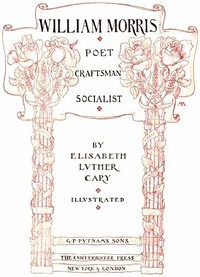
The source record for William Morris: Poet, Craftsman, Socialist — Edition Insights measures this digital text at 83,629 words, 6 hr 4 min estimated reading time, and 12 detected text sections.
The text analysis averages about 26.2 words per sentence, while the detected sections provide another way to judge how the source is divided.
Project Gutenberg metadata also associates the work with “Authors, English -- 19th century -- Biography,” connecting these edition facts with the source record’s subject description.
Explore this collection
These alternatives are selected using recorded categories and estimated reading time.
About 321 minutes
Art History
73,719 recorded words. 43 minutes difference from this book's estimate.
View Gutenberg source #39602About 308 minutes
Art History
70,774 recorded words. 56 minutes difference from this book's estimate.
View Gutenberg source #31965About 424 minutes
Art History
97,344 recorded words. 60 minutes difference from this book's estimate.
View Gutenberg source #32821Search stored excerpts and compare books → Choose by your preferences →
Choices use stored catalog measurements. Estimates vary with reading speed. A shared category is a catalog label, not a claim that two books have the same argument or literary quality.
Search reads excerpt text stored with this catalog and links to its associated Gutenberg record. The connection is stored in the site database; this tool does not recheck that every excerpt is word-for-word identical to that external record. Excerpt search does not cover every chapter and does not verify historical publication dates.
Catalog snapshot checked: 2026-09-25. Coverage: 94 public books, 94 available source excerpts.
Read the complete public-domain text at its original source.
Read on Project GutenbergElisabeth Luther Cary opens her 1902 biography of William Morris by acknowledging that the personal life has been fully covered by J.W. Mackail; her aim is instead to show Morris's career as it appeared to the outer public. The book draws on Morris's own writings, Aymer Vallance's study, H. Buxton Forman's bibliography, and periodical articles. Cary's preface signals a synthetic approach, weaving together existing scholarship rather than presenting new archival discoveries. The resulting portrait emphasizes the coherence of Morris's diverse pursuits—poet, designer, printer, socialist—as expressions of a single temperament.
Cary sharpens her subject by contrasting Morris with John Ruskin, a key influence. She quotes Ruskin's famous passage from The Stones of Venice on the division of labour—"it is not, truly speaking, the labour that is divided; but the men"—but then argues that Ruskin was "altogether too much of an aristocrat, too much of an egoist, to root out classes." Cary asserts that one cannot imagine Ruskin heading a riot in Trafalgar Square, whereas Morris eventually came to preach revolution. This comparison does more than show influence; it reveals Cary's method of defining Morris through difference. She presents Morris as a man who took Ruskin's critique of industrial capitalism and pushed it toward radical action, rejecting halfway measures. The passage also displays Cary's own voice: she is willing to judge historical figures, calling Ruskin an egoist and describing Morris's beliefs as "madly, yet with the downright force that kindled where it struck."
Cary frames Morris's socialism as a "necessity of his temperament" rather than a systematic ideology. She describes his belief that sweeping away civilisation, machinery, and class distinctions would allow a "charming communism" to grow, where "kind hearts would take the place of coronets." The phrasing echoes Tennyson's Lady Clara Vere de Vere, suggesting Cary sees Morris's socialism as partly literary and idealistic. She quotes a private letter in which Morris expresses joy at the thought of "barbarism once more flooding the world" and "real feelings and passions" replacing "wretched hypocrisies." Cary uses this letter to defend Morris against the charge of being a "Capitalist-Socialist," arguing that he did not believe in mere charity but in a "divine discontent" to be spread across all classes. Her analysis stays close to the evidence of Morris's own words, avoiding abstract theory.
The book's illustrations offer a material dimension to Cary's portrait. She reproduces Morris wallpapers and cotton prints—"Acanthus," "Pimpernel," "African Marigold"—with a note that the designs "must not be taken as exact as to colour" because Morris used colours to hand and supervised manufacture through many experimental trials. This technical detail underscores Cary's interest in process over product. The inclusion of Rossetti's portrait of Jane Burden (Mrs. Morris) and the illustration to "The Lady of Shalott" where Launcelot's head is a portrait of Morris links the visual record to biographical fact. Cary does not analyse these images at length, but their presence in the book reinforces her theme of Morris as a man whose life and art were intertwined. The frontispiece portrait "From Life" and the title-page of The Oxford and Cambridge Magazine ground the biography in documentary evidence.
Cary's prose is direct and evaluative, unafraid of strong judgments. She describes Morris's socialist romance News from Nowhere as "his best known Socialistic romance" and notes that its title "was perhaps suggested by Kingsley's" work—a small but telling observation that shows her attention to literary lineage. The book's structure follows a chronological arc from boyhood through Oxford, the Red House years, the founding of Morris & Co., poetry, public life and socialism, the Kelmscott Press, and later writings, ending with a chapter titled "The End." Each chapter draws on published sources, with Cary acting as a synthesizer and commentator. Her preface thanks the Boston Public Library for access to Froissart pages and Kelmscott publications, indicating the research base. The bibliography, prepared by S.C. Cockerell, is included with Cary's own notes appended—a scholarly apparatus that lends authority to the volume.
Cary's biography is best approached as a contemporary portrait, written while Morris's reputation was still being shaped. Readers interested in the intersection of art and politics will find a clear, opinionated guide to Morris's career, though those seeking deep personal detail should supplement with Mackail. The book's strength lies in its integration of Morris's multiple identities—poet, craftsman, socialist—into a single, driven character. Cary's willingness to judge and her sharp contrasts with figures like Ruskin make this a lively, if dated, introduction.
Years at this desk have taught me that even the sturdiest volumes tremble with contained forces. Cary’s portrait of Morris—his handmade socialism, his woven words—feels like solid ground. Yet beside it sits this Catalogue of Violent and Destructive Earthquakes in the Philippines With an Appendix: Earthquakes in the Marianas Islands 1599-1909 — Text and Context, a ledger of shudders beneath calm surfaces. Both whisper of craft against upheaval. I shelve them near each other.
Create a short personal record of your experience with this book.