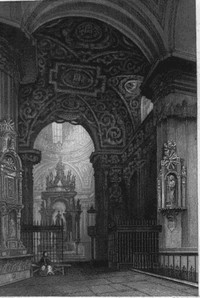
Leonard Williams opens his survey of Spanish decorative arts with a striking image: the reja of the choir in Seville Cathedral, a monumental grille that is both functional and ornamental. This choice is telling, for the reja recurs throughout the volume as a structural device that connects sacred and secular spaces. Williams moves from the cathedral's choir screen to the balconies and window-gratings of private houses, using the same term to describe both. The effect is to suggest a continuum of craftsmanship that blurs the boundary between church and home, public and private.
The Reja as Linking Motif
Williams repeatedly returns to the reja as a point of reference. In the preface he mentions the "Reja of the Choir" as the frontispiece, and the first chapter on iron-work devotes substantial space to these grilles. He quotes a 1659 French traveler who admired the balconies crowded with women, and a Portuguese writer who describes climbing from balcony to balcony as if they were a hand-ladder. The reja thus becomes a thread that ties together ecclesiastical splendor and everyday life, high art and popular anecdote.
Movement Between Sacred and Domestic
The structure of the iron-work chapter mirrors this movement. Williams begins with the great rejas of cathedrals—the Constable's reja in Burgos, the choir screens of Seville—then shifts to private balconies and window-gratings. He notes that between the sixteenth and eighteenth centuries, foreign visitors "omitted to record their admiration" of these domestic features. This juxtaposition is deliberate: the same craftsmen, often Moriscos, produced both. Williams cites ordinances from Granada (1522) about "balconies and rejas in the streets," showing how regulation itself linked the two realms.
Recurring Details: Inscriptions and Artisans
Williams pays close attention to inscriptions and the names of artisans. He reproduces the Latin epitaph of Christophorus Andino, "egregius artifex," from the Constable's reja in Burgos, noting that the words are "of idle purport while the reja of the Constable remains." This emphasis on the maker's identity recurs: he mentions Morisco craftsmen working in Castile as late as 1600, and cites the Portuguese writer Pinheiro da Veiga on their skill. The effect is to anchor the objects in human labor and specific historical moments.
Structure of the Volume: From Precious Metals to Arms
The volume is organized by material: gold and silver, iron, bronzes, arms. But within each chapter, Williams moves from the monumental to the intimate. In the gold and silver section, he describes the Treasure of Guarrazar and the Cross of Angels, then turns to smaller objects like the Moorish casket from Gerona. The arms chapter follows a similar arc, from royal armor to everyday weapons. This consistent pattern—descending from the ceremonial to the practical—gives the book a rhythm that mirrors the movement between sacred and domestic seen in the iron-work chapter.
Readers will find that Williams's method rewards attention to the transitions between chapters and the recurring motifs that link them. The reja, the artisan's name, the shift from cathedral to street—these are not incidental but structural. By following these threads, one can see how Williams constructs a unified vision of Spanish craftsmanship that is both scholarly and vividly particular.
There’s a particular hush in the old workshops, where metal yields to patience—I feel it when Williams lingers on the reja’s intricate lace. It reminds me of a wider, quieter story, one that traces stone and arch through centuries. His grilles and the cathedral’s soaring vaults share that tender, deliberate hand. That other book, A History of Architecture in all Countries, Volume 1, 3rd ed. From the Earliest Times to the Present Day — Background and Themes, holds the same unspoken kinship.