About 512 minutes
Portuguese Architecture — A Closer Reading
Art History
117,545 recorded words. 512 minutes difference from this book's estimate.
View Gutenberg source #29370
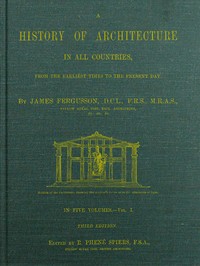
The catalog record for A History of Architecture in all Countries, Volume 1, 3rd ed. From the Earliest Times to the Present Day — Background and Themes provides practical reading context through 235,441 words, 17 hr 4 min estimated reading time, and 60 detected text sections.
The text analysis averages about 23.8 words per sentence, while the detected sections provide another way to judge how the source is divided.
Project Gutenberg metadata also associates the work with “Architecture -- History,” connecting these edition facts with the source record’s subject description.
Explore this collection
These alternatives are selected using recorded categories and estimated reading time.
About 512 minutes
Art History
117,545 recorded words. 512 minutes difference from this book's estimate.
View Gutenberg source #29370About 424 minutes
Art History
97,344 recorded words. 600 minutes difference from this book's estimate.
View Gutenberg source #32821About 364 minutes
Art History
83,629 recorded words. 660 minutes difference from this book's estimate.
View Gutenberg source #39725Search stored excerpts and compare books → Choose by your preferences →
Choices use stored catalog measurements. Estimates vary with reading speed. A shared category is a catalog label, not a claim that two books have the same argument or literary quality.
Search reads excerpt text stored with this catalog and links to its associated Gutenberg record. The connection is stored in the site database; this tool does not recheck that every excerpt is word-for-word identical to that external record. Excerpt search does not cover every chapter and does not verify historical publication dates.
Catalog snapshot checked: 2026-09-25. Coverage: 94 public books, 94 available source excerpts.
Read the complete public-domain text at its original source.
Read on Project GutenbergJames Fergusson's A History of Architecture in all Countries, first published in 1849 and here in its third edition (1893) edited by R. Phené Spiers, is a work of ambitious scope and distinctive voice. The author, a self-taught architectural historian, writes with a confident, often opinionated tone that treats architectural styles as organic developments shaped by cultural and moral forces. The opening sections on Roman architecture exemplify this approach: Fergusson describes Roman art as 'never an indigenous or natural production of the soil or people, but an aggregation of foreign styles,' and he argues that the value of Roman building lies in its role as a transitional phase—'the germs of all that is found in the Middle Ages.' This teleological view, where each period points toward Gothic, structures the entire narrative.
Fergusson does not merely describe buildings; he judges them. His prose is marked by strong evaluative language and sweeping historical claims. For instance, he asserts that during the Roman Republic 'not one monument has come down to our time, even by tradition, worthy of a city of a tenth part of her power and magnitude.' Such statements reveal a historian who sees architecture as a moral index: Rome's early lack of monuments reflects a 'barbarism' that only later, through conquest and accumulation, produced a 'confusion' of styles. Fergusson's voice is that of a critic as much as a chronicler, and his arguments often hinge on the idea of 'transition'—Roman architecture is valuable not in itself but as a 'key' to unlock Gothic mysteries. This teleological framework gives the narrative a driving, almost prophetic quality, as when he writes that Romans advanced 'as steadily towards that result as if a prophetic spirit had guided them.'
The text's pacing reflects its argumentative priorities. Fergusson devotes considerable space to the Roman Republic, which he dismisses as artistically barren, then accelerates through the Empire, where he sees the crucial transition. His description of Rome under the kings—'virtually an Etruscan city'—is brief, while the later imperial period receives detailed analysis of structural innovations and stylistic amalgamation. This uneven tempo is deliberate: Fergusson slows down when he believes architecture is progressing toward a goal (the Gothic), and hurries past periods he deems stagnant. The editor's preface notes that Fergusson's first work, An Historical Enquiry into the True Principles of Beauty in Art (1849), treated the introduction as 'the text' and the rest as illustration—a structure mirrored here, where argument often precedes evidence.
The third edition includes 330 illustrations, and the transcriber's note reveals careful attention to their presentation: 'Scale bars marked '1 in.' have been added to illustrations for which a scale is given (e.g. 50 ft. to 1 in.) to indicate the size of the image as printed in the original book.' This editorial intervention reflects the work's dual nature as both a scholarly text and a visual reference. The illustrations—such as the 'Elevation of Façade of Cologne Cathedral' and the 'Section of the Parthenon, showing the Author’s views as to the admission of light'—are integral to Fergusson's arguments, often supporting his technical observations. The editor, R. Phené Spiers, a Fellow of the Royal Institute of British Architects, likely ensured the accuracy of these visual aids, though the preface notes that a full biography of Fergusson appears in the companion volume on modern styles.
Readers approaching this volume should expect a personal, sometimes polemical history rather than a neutral survey. Fergusson's judgments are always explicit, and his teleological framework—where every style leads toward or away from Gothic—gives the work a coherent but debatable thesis. The third edition's editorial enhancements, including updated illustrations and a preface contextualizing Fergusson's career, make this a useful entry point for understanding 19th-century architectural historiography. For those interested in how Victorian scholars constructed architectural narratives, Fergusson's confident voice and sweeping claims offer a revealing case study.
That rainy afternoon, Fergusson’s weighty volume kept me tracing Romanesque arches until my eyes blurred, yet it was his passing remark on Spanish Moorish ornament that lingered. I closed it, and almost accidentally reached for The Arts and Crafts of Older Spain, Volume 1 (of 3) — A Reader’s Guide, finding the same quiet patience in ironwork and tile that he had merely hinted at.
Build a private reading journal entry for this title.