About 321 minutes
The Industrial Arts in Spain — Background and Themes
Art History
73,719 recorded words. 13 minutes difference from this book's estimate.
View Gutenberg source #39602
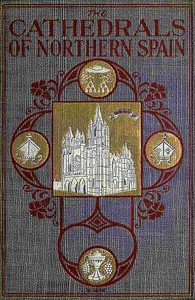
Before opening The Cathedrals of Northern Spain Their History and Their Architecture; Together with Much of Interest Concerning the Bishops, Rulers and Other Personages Identified — Story, Setting & Ideas, the edition data offers a quick orientation: 70,774 words, 5 hr 8 min estimated reading time, and 10 detected text sections.
The text analysis averages about 22.1 words per sentence, while the detected sections provide another way to judge how the source is divided.
Project Gutenberg metadata also associates the work with “Cathedrals -- Spain,” connecting these edition facts with the source record’s subject description.
Explore this collection
These alternatives are selected using recorded categories and estimated reading time.
About 321 minutes
Art History
73,719 recorded words. 13 minutes difference from this book's estimate.
View Gutenberg source #39602About 275 minutes
Art History
63,078 recorded words. 33 minutes difference from this book's estimate.
View Gutenberg source #44391About 364 minutes
Art History
83,629 recorded words. 56 minutes difference from this book's estimate.
View Gutenberg source #39725Search stored excerpts and compare books → Choose by your preferences →
Choices use stored catalog measurements. Estimates vary with reading speed. A shared category is a catalog label, not a claim that two books have the same argument or literary quality.
Search reads excerpt text stored with this catalog and links to its associated Gutenberg record. The connection is stored in the site database; this tool does not recheck that every excerpt is word-for-word identical to that external record. Excerpt search does not cover every chapter and does not verify historical publication dates.
Catalog snapshot checked: 2026-09-25. Coverage: 94 public books, 94 available source excerpts.
Read the complete public-domain text at its original source.
Read on Project GutenbergCharles Rudy opens his 1905 guide with a frank admission: Spain's architecture is 'both agreeable and disagreeable, but it is all of it peculiarly Spanish.' He warns readers arriving from France with a Cook's ticket to discard foreign aesthetic standards, arguing that a cathedral like León—often praised as 'pure Gothic'—is in fact 'nothing less Spanish.' This editorial note traces how Rudy structures his book around the tension between imported architectural ideals and the Iberian preference for complex, layered compositions.
Rudy frequently shifts from dry historical summary to vivid anecdote, a structural pattern that animates his cathedral histories. In the Palencia chapter, he recounts how King Sancho el Mayor, hunting among weeds covering a Roman fortress, chased a boar into a cave that turned out to be a subterranean chapel. The king's arm was 'detained in mid-air by an invisible hand' as he tried to spear the animal. The story moves from ruin to miracle to reestablishment of the see in a few paragraphs. This technique—juxtaposing archaeological fact with local legend—gives the book a rhythm that mirrors the layered history of the buildings themselves.
Water appears repeatedly as an agent of divine intervention or destruction. Rudy describes a bishop who, 'disgusted with the heresy practised at large,' caused river waters to leave their bed and inundate Palencia. The Visigoths 'wreaked greater vengeance' on the city, leaving 'not one stone remaining.' The Arab invasion 'devastated a second time,' and Alfonso I may have 'completely wrecked' the town. Yet each destruction is followed by renewal: Sancho's boar hunt, the erection of a church over the chapel, and the city's eventual prosperity. This cycle of wreck and rebuilding becomes a structural motif, reinforcing Rudy's argument that Spanish cathedrals are best understood as palimpsests.
Rudy treats each cathedral not merely as a monument but as a character in regional power struggles. Palencia, he notes, was 'continually the seat of dissident noblemen and thwarted heirs to the throne.' Its bishops bore the title 'hecho un rey y un papa'—king and pope—yet many lived at court rather than in their see. The city's siding with the Comuneros against Charles V led to its decline, ceding place to Valladolid. By weaving political narrative into architectural description, Rudy shows how a building's fate was tied to the ambitions of bishops, kings, and rebels. The structure of each chapter thus mirrors the layered conflicts that shaped the cathedral's physical form.
Rudy's preface is unusually direct. He declares his 'love for Spain is unbounded,' then immediately criticizes those who have wronged her—'being her sons.' He dismisses the notion of 'pure' styles, insisting that 'personality is consequently ever uppermost in all art criticism.' This personal, opinionated tone sets the stage for a book that is as much about the author's evolving taste as about the cathedrals themselves. Rudy admits that those who have 'lived years in Spain' learn to admire complex compositions like Toledo and Santiago. The preface thus functions as a reader's orientation: expect not a dry catalogue but a subjective, engaged tour shaped by long residence and a willingness to embrace the 'peculiarly Spanish.'
Rudy's book rewards readers who treat each chapter as a self-contained essay rather than a systematic guide. The recurring pattern of destruction and legend, the political subtext, and the author's frank opinions all contribute to a work that is as much about how to see Spanish architecture as about the buildings themselves. For those willing to follow Rudy's advice and 'turn a Spaniard, if but for a few days,' the cathedrals of northern Spain emerge not as flawed copies of French models but as vibrant, contradictory monuments to a complex history.
I keep thinking about that little boar leading the king to the hidden chapel, how faith sometimes arrives sideways. It reminded me of sitting with Rome: A Sketch-Book — Edition Insights years ago, feeling the same patience—not needing to grasp everything at once, just letting old stones hold their own quiet truths. Both books ask for stillness, not judgment.
Answer a few questions and save a private reflection on this device.