About 364 minutes
William Morris: Poet, Craftsman, Socialist — Edition Insights
Art History
83,629 recorded words. 60 minutes difference from this book's estimate.
View Gutenberg source #39725
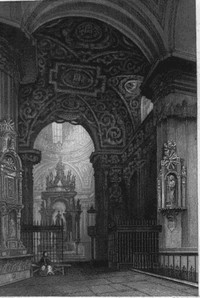
Before opening The Picturesque Antiquities of Spain Described in a series of letters, with illustrations representing Moorish palaces, cathedrals, and other monuments of art, contained — Text and Context, the edition data offers a quick orientation: 97,344 words, 7 hr 4 min estimated reading time, and 10 detected text sections.
The text analysis averages about 29.5 words per sentence, while the detected sections provide another way to judge how the source is divided.
Project Gutenberg metadata also associates the work with “Art, Islamic,” connecting these edition facts with the source record’s subject description.
Explore this collection
These alternatives are selected using recorded categories and estimated reading time.
About 364 minutes
Art History
83,629 recorded words. 60 minutes difference from this book's estimate.
View Gutenberg source #39725About 512 minutes
Art History
117,545 recorded words. 88 minutes difference from this book's estimate.
View Gutenberg source #29370About 321 minutes
Art History
73,719 recorded words. 103 minutes difference from this book's estimate.
View Gutenberg source #39602Search stored excerpts and compare books → Choose by your preferences →
Choices use stored catalog measurements. Estimates vary with reading speed. A shared category is a catalog label, not a claim that two books have the same argument or literary quality.
Search reads excerpt text stored with this catalog and links to its associated Gutenberg record. The connection is stored in the site database; this tool does not recheck that every excerpt is word-for-word identical to that external record. Excerpt search does not cover every chapter and does not verify historical publication dates.
Catalog snapshot checked: 2026-09-25. Coverage: 94 public books, 94 available source excerpts.
Read the complete public-domain text at its original source.
Read on Project GutenbergNathaniel Armstrong Wells opens his 1846 volume with a candid admission: his architectural descriptions are not minute, and he deliberately avoids technical terms because, as he writes, "the most intelligent in such subjects are scarcely sufficiently agreed on the application of technical terms." This self-awareness shapes the entire work. Wells positions himself as a pioneer for a more scientific pen, aiming to satisfy popular curiosity rather than specialist rigor. His letters, written after the Spanish revolution, note that ecclesiastical confiscations have stripped ceremonies of former splendour, shifting the picturesque from "animated grouping" to "the dead background of stone and marble." The result is a travelogue that foregrounds ruins, castles, and cathedrals while weaving in historical narratives drawn from local traditions and published sources like Haro's Nobiliario.
Wells repeatedly signals his own limitations. In the preface he admits his work "would have possessed greater utility, had the architectural descriptions been more minute," yet he hopes this imperfection is balanced by a broader appeal. He avoids Gothic technicalities because the occasion forbade them, and because no standard vocabulary existed. This stance is not false modesty: the excerpts show him describing a castle's "second enclosure" and "exterior defences" without using terms like barbican or machicolation. Instead, he focuses on proportions, materials, and the stories attached to buildings. His method is observational rather than analytical, and he explicitly states his ambition is to "pioneer the path" for later scholars.
Wells treats monuments as prompts for historical digression. In the excerpt on the Castle of Guadamur, he devotes far more space to the lineage of the Counts of Fuensalida than to the building's architecture. He recounts how Pedro Lopez de Ayala, the builder, was a favourite of Enrique IV despite his deafness, and how his wife Doña Maria de Silva helped foil a rebellion. Wells draws on Haro's Nobiliario, a work he praises as "drawn up with care and research," to adjudicate between competing origin stories. This approach—using architecture as a springboard for anecdotal history—is consistent throughout the letters, though the excerpts do not reveal whether he applies it equally to all sites.
Wells's letters are explicitly post-revolutionary. He notes that the confiscation of ecclesiastical revenues has stripped processions of their former splendour, transferring the picturesque from "bright colours of animated grouping" to static monuments. This context explains why his descriptions emphasize stone and marble over living pageantry. The revolution also colours his choice of subjects: many religious buildings had been stripped of their treasures, leaving only the architecture. Wells does not lament this loss in sentimental terms; instead, he presents it as a factual condition that shapes his work. The reader should expect a travelogue that is more archaeological than celebratory, grounded in the material remains of a transformed society.
Wells's letters reward readers who enjoy historical anecdote woven into topographical description. Because he avoids technical jargon, the book is accessible to those new to Spanish architecture, but specialists may find the lack of detail frustrating. The excerpts suggest a work that is as much about the stories Spaniards told about their buildings as about the buildings themselves. Approach it as a period piece—a gentleman-traveler's record of a Spain in transition, filtered through a self-deprecating but curious mind.
Wells walked those Spanish halls without professional pretense, simply recording what struck his eye and heart. Years later, another voice traced the same northern cathedrals with deeper architectural rigor, yet both shared that essential reverence for old stones and the quiet lives once sheltered within them. Reading The Cathedrals of Northern Spain Their History and Their Architecture; Together with Much of Interest Concerning the Bishops, Rulers and Other Personages Identified — Story, Setting & Ideas, I felt that same unhurried pilgrimage, an old friend met upon familiar ground.
Save your reaction, strongest insight, and memorable passage.