About 49 minutes
Economy of the Round Dairy Barn — A Closer Reading
Design Photography
11,130 recorded words. 10 minutes difference from this book's estimate.
View Gutenberg source #38321
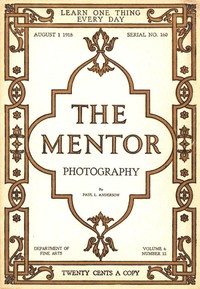
This digital edition of The Mentor: Photography, Vol. 6, Num. 12, Serial No. 160, August 1, 1918 — Themes and Context is described by source-level measurements including 13,463 words, 59 min estimated reading time, and 8 detected text sections.
The text analysis averages about 20.1 words per sentence, while the detected sections provide another way to judge how the source is divided.
Project Gutenberg metadata also associates the work with “Photography,” connecting these edition facts with the source record’s subject description.
Explore this collection
These alternatives are selected using recorded categories and estimated reading time.
About 49 minutes
Design Photography
11,130 recorded words. 10 minutes difference from this book's estimate.
View Gutenberg source #38321About 43 minutes
Design Photography
9,782 recorded words. 16 minutes difference from this book's estimate.
View Gutenberg source #59801About 31 minutes
Design Photography
7,052 recorded words. 28 minutes difference from this book's estimate.
View Gutenberg source #60214Search stored excerpts and compare books → Choose by your preferences →
Choices use stored catalog measurements. Estimates vary with reading speed. A shared category is a catalog label, not a claim that two books have the same argument or literary quality.
Search reads excerpt text stored with this catalog and links to its associated Gutenberg record. The connection is stored in the site database; this tool does not recheck that every excerpt is word-for-word identical to that external record. Excerpt search does not cover every chapter and does not verify historical publication dates.
Catalog snapshot checked: 2026-09-25. Coverage: 94 public books, 94 available source excerpts.
Read the complete public-domain text at its original source.
Read on Project GutenbergThe issue opens not with a technical lecture but with a letter from a missionary in West China, Daniel S. Dye, who describes using The Mentor in his classroom. This framing immediately positions photography as a tool for education and cross-cultural exchange, not merely a craft. Anderson then shifts into a rigorous explanation of how photography serves science, detailing the use of ultra-violet light to capture objects invisible to the naked eye. The juxtaposition of a personal testimonial with precise optical theory sets up the volume’s dual focus: accessible instruction and scientific depth.
The first substantive text is a letter from Daniel S. Dye, a missionary at West China Union University. He praises The Mentor for being “not learned” yet providing a “most readable review” with “pithy editorials and discriminatively selected pictures.” Dye describes using the magazine’s pictures for “identification” or “information tests” and posting them on a bulletin board, where they attract students “between classes.” This testimonial is not a mere endorsement; it establishes the publication’s intended audience—general readers, teachers, and those far from cultural centers—and its practical utility. Anderson lets a real user define the magazine’s value before offering his own instruction.
Anderson devotes a substantial passage to explaining how photography aids microscopy and astronomy. He notes that the camera “has no such limitations” as the human eye, which can only perceive waves between “four-ten-thousandths and seven-ten-thousandths of a millimeter.” By using ultra-violet light, the photographic plate can record objects “so small that they must forever remain invisible to the naked eye.” This is not a simple list of applications; Anderson walks through the physics of wave length and the concept of the ether, acknowledging that the ether “has never been observed nor its actual existence proven.” He treats readers as capable of following a chain of reasoning from wave theory to practical scientific photography.
In a later section, Anderson describes a technique called “dark ground illumination,” where “an opaque background is placed behind the object, and the light is allowed to fall on it from the sides.” This method reveals details that ordinary transmitted light obscures. The passage is brief but significant: it shows Anderson’s interest in how altering the conditions of observation can change what is seen. He does not merely list techniques; he explains the principle behind each, encouraging readers to think about light and visibility rather than just memorize steps. This approach recurs throughout the excerpts, where technical explanations are paired with concrete examples.
Anderson balances scientific exposition with practical guidance for photographers. He discusses the use of “lantern-slides” from negatives for lectures, and mentions “advertising illustration” as an example of commercial photography. A photograph by Struss, credited to the Cleveland Metal Products Co., illustrates how photography serves industry. The thumb-print photograph, made visible by “dusting with a fine powder,” shows forensic applications. These examples are not exhaustive; they are selected to demonstrate photography’s range. Anderson’s method is to present a principle—such as the camera’s accuracy—and then show its application in science, commerce, and detective work, giving readers a framework for understanding photography’s broader utility.
Readers approaching this volume for the first time should note how Anderson builds from a user’s letter to abstract theory to concrete examples. The opening testimonial is not incidental; it signals that the text values practical use over academic rigor. The scientific passages reward careful reading, as Anderson explains concepts like wave length and dark ground illumination without oversimplifying. The later sections on commercial and forensic photography ground the theory in everyday practice. This structure—personal, theoretical, applied—makes the volume both instructive and accessible.
This primer’s gentle insistence on seeing light as both wave and meaning reminded me of my father’s old Kodak manual, the one I read under a summer porch, pages smelling of dust. That same patient unraveling—how a tilted horizon changes a portrait’s mood—felt like a secret passed hand to hand. Later, The Cubies' ABC — Background and Themes offered a playful echo of that clarity, as if shapes themselves could learn to speak.
Use these questions to collect your thoughts before moving on.