About 17 minutes
Donahey's Cartoons — Edition Insights
Design Photography
3,833 recorded words. 0 minutes difference from this book's estimate.
View Gutenberg source #58878
Before opening Pictures of People — Story, Setting & Ideas, the edition data offers a quick orientation: 3,909 words, 17 min estimated reading time, and 2 detected text sections.
The text analysis averages about 17.1 words per sentence, while the detected sections provide another way to judge how the source is divided.
Project Gutenberg metadata also associates the work with “Caricatures and cartoons -- United States,” connecting these edition facts with the source record’s subject description.
Explore this collection
These alternatives are selected using recorded categories and estimated reading time.
About 17 minutes
Design Photography
3,833 recorded words. 0 minutes difference from this book's estimate.
View Gutenberg source #58878About 20 minutes
Design Photography
4,517 recorded words. 3 minutes difference from this book's estimate.
View Gutenberg source #41423About 31 minutes
Design Photography
7,052 recorded words. 14 minutes difference from this book's estimate.
View Gutenberg source #60214Search stored excerpts and compare books → Choose by your preferences →
Choices use stored catalog measurements. Estimates vary with reading speed. A shared category is a catalog label, not a claim that two books have the same argument or literary quality.
Search reads excerpt text stored with this catalog and links to its associated Gutenberg record. The connection is stored in the site database; this tool does not recheck that every excerpt is word-for-word identical to that external record. Excerpt search does not cover every chapter and does not verify historical publication dates.
Catalog snapshot checked: 2026-09-25. Coverage: 94 public books, 94 available source excerpts.
Read the complete public-domain text at its original source.
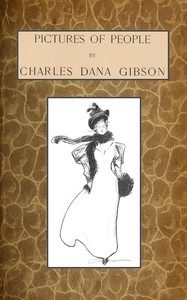
Read on Project GutenbergCharles Dana Gibson's Pictures of People (1896) is a collection of drawings and captions that skewers American social life with a light but pointed touch. The catalog subjects—caricatures and cartoons, American wit and humor, and women—are all borne out in the excerpts, which include gags about marriage, widowhood, and social climbing. Gibson, best known for creating the "Gibson Girl," here turns his eye to a broader cast of characters, from the "big American girl" to the "inconsolable young widow." The humor often relies on a single line or a short exchange, as in the caption for "A Drama": "She has just prevented his proposing by telling him she is engaged."
The catalog subject "Women -- Caricatures and cartoons" is amply justified. Gibson's women are often the punchline, as in "Her Nightmare" ("How she saw herself") or the widow who cannot see past her own loss. In one exchange, a "sympathetic plain friend" tells the widow how her late husband "stopped and spoke to me with such a sunny greeting," only to have the widow reply that he "could find something pleasant to say" to any woman, no matter how "humble or homely." The joke is on the friend, but the widow's self-absorption is the real target. Elsewhere, "The Leading Features of a Liberal Education" and "Yale versus Vassar" suggest that women's education is a subject for satire.
Many drawings take aim at the rituals of courtship, marriage, and mourning. "After the Quarrel" and "Reading the Will" hint at domestic strife, while "Extract from the Will" includes a clause cutting off a widow's inheritance if she remarries. The one-liner for "A Little Story"—"By a sleeve"—is cryptic, but the doctor's mix-up of a note and a prescription ("Great Scott! I thought it was a prescription and made it up for her") shows how easily social transactions go awry. The setting of "In a London Theatre" and "At the Royal Academy" (where a painting is "Skied!") extends the satire to the art world.
Because the excerpts consist almost entirely of captions and titles, the visual component—Gibson's drawings—is absent. The catalog subject "Drawing, American" is thus only partially represented. We cannot assess the style, composition, or expressiveness of the images, which were the main draw for contemporary audiences. Similarly, the sequence of drawings is unclear; the list of titles may not reflect the book's actual order. The humor, while evident in the captions, may depend on visual cues we lack. The dedication "To a Big American Girl" and the inclusion of Parisian scenes ("Moulin Rouge," "Le Chat Noir") suggest a transatlantic perspective, but without the drawings, the full effect is lost.
Readers should approach Pictures of People as a period piece whose humor relies on social conventions now over a century old. The captions are often self-contained, making the book easy to dip into, but the drawings are essential to the experience. The Project Gutenberg edition reproduces the text only, so for the full effect, seek out the original illustrated version. Gibson's wit is sharp, but it is also of its time—particularly in its treatment of women and class.
Gibson’s sharp little jokes about courtship made me recall flipping through my grandmother’s old magazines, where every face seemed to hide a wink. That same playful prickliness surfaced again in The Cubies' ABC — Background and Themes, where the satire felt gentler, more like a nursery rhyme that knows it’s being naughty. Both left me smiling alone in the lamplight.
Your answers remain private and are stored only in this browser.