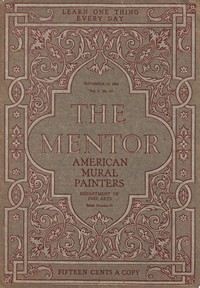
Arthur Hoeber’s 1914 survey of American mural painters moves through its subjects with a methodical, almost architectural logic. The text opens with Elihu Vedder, then proceeds to John Singer Sargent, Edwin Austin Abbey, and a host of others, each presented in a sequence that mirrors the physical arrangement of murals within public buildings. The Boston Public Library recurs as a focal point, its chambers described as containing works by Sargent, Abbey, Elmer E. Garnsey, and John Elliott. This repeated return to one building gives the essay a cohesive spatial anchor, even as it ranges across the country.
A Gallery of Artists in Sequence
The essay’s structure is straightforward: a series of monographs, each devoted to a single painter, arranged in a numbered sequence. The first monograph covers Elihu Vedder, the second likely treats another artist, and so on. This serial format, typical of The Mentor series, allows Hoeber to present each figure as a discrete subject while maintaining an overarching theme. The transitions between artists are abrupt, with no connective tissue beyond the shared category of mural painting. This creates a reading experience akin to walking through a gallery, stopping before each work in turn. The text does not compare or contrast the artists directly; instead, it relies on the reader to hold each portrait in mind as the next is introduced.
Recurring Motifs: Allegory and Symbolism
Hoeber repeatedly emphasizes allegorical and symbolic content in the murals he describes. Of Sargent’s Boston Library decorations, he notes “profound symbolism” and “elaborate symbolism, thoroughly consistent, wonderfully worked out.” Vedder’s panels in the Library of Congress represent “Government in its various phases, good and corrupt, of much invention in their allegorical way.” The word “symbolism” appears multiple times, and “allegorical” is used to characterize both Vedder’s and Sargent’s work. This recurring vocabulary suggests that for Hoeber, the intellectual ambition of mural painting lies in its ability to convey abstract ideas through visual narrative. The reader is invited to see these works not merely as decoration but as coded statements about morality, history, and power.
Movement Between Buildings and Cities
The essay’s geography shifts from New York to Boston to Washington, D.C., and to Harrisburg, Pennsylvania, with brief mentions of Pittsburgh and other locations. The Boston Public Library receives the most sustained attention, described as offering “opportunity for decorative work of an unusual nature.” The Congressional Library at Washington “offered still greater opportunities,” engaging a longer list of painters. This movement from one building to another structures the narrative as a tour of American civic architecture. Hoeber notes the color schemes, the placement of panels, and the collaborative nature of these projects—Garnsey planned the color scheme for the Congressional Library, while Miss Violet Oakley completed Abbey’s unfinished work in Harrisburg. The reader follows the author’s gaze as it moves from frieze to lunette to ceiling, from one city’s library to another’s capitol.
The Role of the Individual Artist
Despite the collective nature of mural projects, Hoeber focuses on individual artists and their distinctive contributions. He quotes Vedder’s autobiographical remarks about his parents, giving a personal touch. Sargent is described as “thoroughly cosmopolitan,” his American parentage his “sole claim to nationality.” Abbey’s Holy Grail series is called “perhaps the most popular mural work in this country.” The text balances general descriptions of buildings with specific attributions, naming the painter responsible for each decoration. This dual focus—on the building as a whole and on the artist’s hand within it—mirrors the tension between architecture and painting that defines mural art. The essay does not resolve this tension but lets it stand, much as the murals themselves occupy a space between wall and picture.
Hoeber’s essay rewards a reader who attends to its structure as much as its content. The sequence of artists, the repeated return to the Boston Public Library, and the persistent vocabulary of allegory and symbolism all shape the argument that American mural painting is a serious, intellectually ambitious art. Readers may wish to compare the treatment of different artists within the same building, or to trace how the essay’s movement between cities reflects the spread of mural painting as a national phenomenon.
That old volume on mural painters stayed with me—the way it circled back to allegory and the Boston library, never quite landing anywhere. It felt like wandering a building at dusk. It reminded me of how The Whistler book — Context and Discussion lingers, too, all atmosphere and quiet insistence on looking, rather than explaining.