About 48 minutes
The Mentor: American Mural Painters, vol. 2, Num 15, Serial No. 67, September 15, 1914 — Inside the Classic
Architecture
10,948 recorded words. 1 minutes difference from this book's estimate.
View Gutenberg source #50673
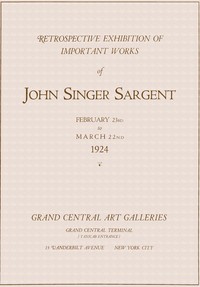
The catalog record for Retrospective exhibition of important works of John Singer Sargent, February 23rd to March 22nd, 1924 — Edition Insights provides practical reading context through 11,268 words, 49 min estimated reading time, and 10 detected text sections.
The text analysis averages about 14.8 words per sentence, while the detected sections provide another way to judge how the source is divided.
Project Gutenberg metadata also associates the work with “Sargent, John Singer, 1856-1925,” connecting these edition facts with the source record’s subject description.
Explore this collection
These alternatives are selected using recorded categories and estimated reading time.
About 48 minutes
Architecture
10,948 recorded words. 1 minutes difference from this book's estimate.
View Gutenberg source #50673About 51 minutes
Architecture
11,639 recorded words. 2 minutes difference from this book's estimate.
View Gutenberg source #61736About 53 minutes
Architecture
12,069 recorded words. 4 minutes difference from this book's estimate.
View Gutenberg source #51677Search stored excerpts and compare books → Choose by your preferences →
Choices use stored catalog measurements. Estimates vary with reading speed. A shared category is a catalog label, not a claim that two books have the same argument or literary quality.
Search reads excerpt text stored with this catalog and links to its associated Gutenberg record. The connection is stored in the site database; this tool does not recheck that every excerpt is word-for-word identical to that external record. Excerpt search does not cover every chapter and does not verify historical publication dates.
Catalog snapshot checked: 2026-09-25. Coverage: 94 public books, 94 available source excerpts.
Read the complete public-domain text at its original source.
Read on Project GutenbergThe 1924 retrospective of John Singer Sargent at Grand Central Art Galleries was not merely a display of paintings; it was a carefully orchestrated event that intertwined artistic prestige with institutional ambition. The catalog opens with a foreword detailing the Painters and Sculptors Association, a non-profit organization designed to support living American artists through a subscription model. This context frames the exhibition as both a celebration of Sargent's career and a strategic move to elevate American art commerce.
The catalog lists 46 works, each loaned by prominent collectors, and notes that the collection was insured for nearly a million dollars—a figure that underscores the financial stakes of such a retrospective. Sargent himself selected and approved all paintings, lending his personal authority to the event.
The foreword presents the Painters and Sculptors Association as a national clearing house, not a local sales venue. Its lay-members pledged $600 annually for three years, while artist members contributed one work per year. This structure aimed to create a sustainable market for American art. The catalog emphasizes the association's reach, listing cities from New York to San Francisco, and boasts that its membership includes presidents and vice-presidents of ten major museums. This language reveals a deliberate effort to position the exhibition within a broader cultural and economic network.
The exhibition's loan list reads like a who's who of early 20th-century American society. Works were lent by individuals such as Mrs. Phipps, Honorable Henry White, and Livingston Davis. Portrait titles like The Honorable Mrs. Frederick Guest and Sketch of Mrs. Henry White—née Margaret Stuyvesant Rutherford highlight Sargent's role as a painter of the elite. The catalog does not describe the paintings themselves, but the list alone traces a network of wealth and influence, suggesting that the exhibition was as much about social capital as artistic merit.
An extended advertisement for M. Grieve Company frames occupies several pages of the catalog, tracing the family's frame-making lineage back to 1721 in a Flemish village. The text claims that Grieve frames were crafted with “an almost scientific appreciation of what would enhance the intelligent understanding of the picture.” This insertion blurs the line between catalog and commercial promotion, revealing how the exhibition served multiple interests. The detailed history of the Grieve family—from Belgium to London to New York—mirrors the catalog's own narrative of artistic tradition meeting modern commerce.
Readers should approach this catalog as a document of institutional and commercial forces as much as a record of Sargent's art. The foreword, loan list, and frame advertisement each tell a story about how American art was marketed, valued, and displayed in the 1920s. The catalog does not offer critical analysis of Sargent's paintings; instead, it provides a snapshot of the ecosystem that supported his career. Pay attention to the language of insurance, subscription, and pedigree—these details reveal the economic realities behind the exhibition.
The 1924 Sargent catalog still smells of varnish and gilt, though its pages list only loans and frames. Flipping past the M. Grieve advertisement, I often recall another shelf, quieter, where British Marine Painting — Text and Context waits with its own patient tides. Both books speak of hands that shaped light—one for portraiture, one for water—each a held breath between exhibition and sea.
Answer a few questions and save a private reflection on this device.