About 51 minutes
Bermuda Houses — Key Ideas to Explore
Architecture
11,639 recorded words. 2 minutes difference from this book's estimate.
View Gutenberg source #61736
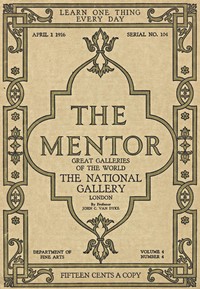
The catalog record for The Mentor: The National Gallery—London, Vol. 4, Num. 4, Serial No. 104, April 1, 1916 Great Galleries of the World — Reading Notes provides practical reading context through 12,069 words, 53 min estimated reading time, and 7 detected text sections.
The text analysis averages about 16.4 words per sentence, while the detected sections provide another way to judge how the source is divided.
Project Gutenberg metadata also associates the work with “Painting,” connecting these edition facts with the source record’s subject description.
Explore this collection
These alternatives are selected using recorded categories and estimated reading time.
About 51 minutes
Architecture
11,639 recorded words. 2 minutes difference from this book's estimate.
View Gutenberg source #61736About 49 minutes
Architecture
11,268 recorded words. 4 minutes difference from this book's estimate.
View Gutenberg source #70823About 58 minutes
Architecture
13,318 recorded words. 5 minutes difference from this book's estimate.
View Gutenberg source #38879Search stored excerpts and compare books → Choose by your preferences →
Choices use stored catalog measurements. Estimates vary with reading speed. A shared category is a catalog label, not a claim that two books have the same argument or literary quality.
Search reads excerpt text stored with this catalog and links to its associated Gutenberg record. The connection is stored in the site database; this tool does not recheck that every excerpt is word-for-word identical to that external record. Excerpt search does not cover every chapter and does not verify historical publication dates.
Catalog snapshot checked: 2026-09-25. Coverage: 94 public books, 94 available source excerpts.
Read the complete public-domain text at its original source.
Read on Project GutenbergJohn C. Van Dyke’s 1916 guide to the National Gallery, London, is less a neutral catalog than a spirited, opinionated walk through the rooms. Writing for The Mentor series, Van Dyke does not simply list masterpieces; he judges them, often dismissing celebrated works as “thin, cold” or “school pieces.” The catalog subjects—Painting and the National Gallery—frame the text, but the excerpts reveal a writer more interested in connoisseurship than comprehensive survey.
Van Dyke organizes the gallery by national schools—Italian, Flemish, Dutch—but his prose is evaluative, not descriptive. He calls Piero della Francesca’s panels “the very noblest kind of fine art,” while dismissing Raphael’s “Ansidei Madonna” as a work of his youth. The Leonardo “Madonna of the Rocks” is deemed disputed, with Van Dyke suggesting the master “had some hand in its production” but was likely assisted by a pupil. Such judgments reflect early 20th-century taste and the author’s authority as a professor, but they also show how the text prioritizes personal assessment over neutral documentation.
Van Dyke repeatedly contrasts meticulous surface realism with broader artistic achievement. He praises Jan Van Eyck’s Arnolfini portraits and Gerard David’s panels, but criticizes Gossart’s “Adoration of Kings” for its deceptive realism, quoting Sir Joshua Reynolds that art consists of more than “cats and fiddles to be picked up.” Rubens, by contrast, is celebrated for his “large brush” and ability to give “body and bulk of things.” This tension between craft and mere illusion runs through the text, revealing Van Dyke’s criteria for greatness.
Van Dyke repeatedly warns that the National Gallery offers only isolated examples of Italian masters. He advises that to judge Raphael, one must go to Florence and Rome; for Correggio, to Parma. The Florentine trio—Michelangelo, Raphael, Leonardo—are represented by “rather dubious examples.” This caveat is a recurring structural feature, reminding readers that the collection’s strength lies in Northern European works, and that Italian masterpieces seen in London may not reflect the artists’ full range. The text thus functions as a guide to the gallery’s limitations as much as its holdings.
Readers should approach Van Dyke’s text as a period document of art criticism rather than a definitive guide. His confident rankings and dismissals reflect early 20th-century connoisseurship, not current scholarship. The excerpts show a writer deeply engaged with questions of attribution and quality, but also one who assumes his audience shares his tastes. For a modern reader, the value lies in observing how a single authoritative voice shaped public understanding of a national collection.
Van Dyke’s measured doubts about an attribution remind me of feeling my own way through a strange craft, guessing at a cutter’s hand beneath the polish. That quiet uncertainty lingers warmly. I found a similar patience in Cameo Cutting — A Reader’s Guide, where careful looking becomes its own gentle reward.
Build a private reading journal entry for this title.