About 268 minutes
Hopes and Fears for Art — Reading Notes
Architecture
61,551 recorded words. 1 minutes difference from this book's estimate.
View Gutenberg source #3773
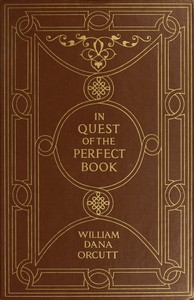
The source record for In quest of the perfect book — Background and Themes measures this digital text at 61,206 words, 4 hr 27 min estimated reading time, and 15 detected text sections.
The text analysis averages about 25.5 words per sentence, while the detected sections provide another way to judge how the source is divided.
Project Gutenberg metadata also associates the work with “Books -- History,” connecting these edition facts with the source record’s subject description.
Explore this collection
These alternatives are selected using recorded categories and estimated reading time.
About 268 minutes
Architecture
61,551 recorded words. 1 minutes difference from this book's estimate.
View Gutenberg source #3773About 268 minutes
Architecture
61,627 recorded words. 1 minutes difference from this book's estimate.
View Gutenberg source #59473About 265 minutes
Architecture
60,838 recorded words. 2 minutes difference from this book's estimate.
View Gutenberg source #61986Search stored excerpts and compare books → Choose by your preferences →
Choices use stored catalog measurements. Estimates vary with reading speed. A shared category is a catalog label, not a claim that two books have the same argument or literary quality.
Search reads excerpt text stored with this catalog and links to its associated Gutenberg record. The connection is stored in the site database; this tool does not recheck that every excerpt is word-for-word identical to that external record. Excerpt search does not cover every chapter and does not verify historical publication dates.
Catalog snapshot checked: 2026-09-25. Coverage: 94 public books, 94 available source excerpts.
Read the complete public-domain text at its original source.
Read on Project GutenbergOrcutt begins not with his own story but with a foreword to a third edition, where he recounts being told long ago that a foreword is 'an admission on the part of an author that he has failed to tell his story.' He then pivots, claiming this book is not his story but 'the story of the Book,' and notes that since writing, the Gutenberg Bible's auction price leaped from $120,000 to $305,000—a dramatic proof that 'the Book has come into its own.' This framing sets a dual focus: the material and commercial value of books as objects, and the personal, romantic quest behind their making.
The excerpts that follow reveal a work built from reminiscences and reflections, not a systematic history. Orcutt moves between encounters with authors like Maurice Hewlett and discussions of typography, always circling back to Italy and the humanist scribes whose hand letters inspired a special typeface. The reader is invited to watch a bookman at work, connecting people, places, and printed pages.
Orcutt opens with a paradox: he includes a foreword while quoting advice that forewords are either admissions of failure or insults to readers. He resolves this by insisting the book is not his story but the Book's—a romance that has since become drama, as the Gutenberg Bible's value soared. This self-aware gesture signals that Orcutt is less concerned with linear narrative than with the evolving life of printed works. The foreword also reveals his audience: readers who find books 'something more than paper and type and binders’ boards.' One correspondent wrote that after reading, 'many [books] now take on new significance.' Orcutt thus positions himself as a guide to seeing books as artifacts with hidden stories, not just texts.
Orcutt's meeting with Maurice Hewlett illustrates his method: a personal anecdote that opens onto larger themes. He describes Hewlett's dual nature—whimsical in his country garden, crisp and decisive in a London club—and traces his style to daily work in the Record Office studying parchments from William the Conqueror. This detail echoes Orcutt's own interest in the material roots of literature. Their conversation turns to humanism, a 'hobby' of Hewlett's, and they quote Philippe Monnier's definition: humanism is not just love of antiquity but 'the worship of it, carried so far that it forces one to reproduce.' Orcutt connects this to his own work designing a typeface based on humanistic scribes, linking past and present through the physical act of making books.
Italy appears repeatedly as a source of inspiration. Orcutt dedicates the volume 'To Italy,' citing its 'Master-Spirits in Art, Typography, and Literature' as contributors to the perfect book. He mentions his collaboration with Doctor Guido Biagi, librarian of the Laurenziana Library in Florence, and his work there designing a typeface based on 'the beautiful hand letters of the humanistic scribes.' This is not abstract admiration: Orcutt grounds his quest in specific places and practices. The excerpts suggest that for him, the perfect book is not a single object but an ideal approached through craft, history, and the tangible traces of earlier makers. Readers attentive to these details will find a memoir that is also a manual of looking.
Orcutt repeatedly calls the story of the Book 'Romance,' yet he anchors that romance in hard numbers: the Gutenberg Bible's leap from $120,000 to $305,000. This juxtaposition of aesthetic and market value runs through the excerpts. He is gratified that readers now see books with 'new significance,' but he also records the precise prices and reprint dates of his own volume. The foreword notes that the first edition was published in September 1926 and reprinted in October and November—a sign of commercial success. Orcutt does not resolve the tension between art and commerce; he lets it stand as part of the quest. For a first-time reader, this duality is worth tracking: how does Orcutt balance reverence for the book as an object of beauty with its life as a commodity?
Orcutt's memoir rewards readers who treat it as a series of encounters rather than a thesis. The excerpts offer no single definition of the perfect book, but they do show a man who found it in fragments: a typeface, a conversation, a rising auction price. Pay attention to the physical details—the size of a manuscript, the feel of a garden walk, the exact wording of a quoted letter. These are the clues Orcutt leaves for those who, like his correspondents, want to see their own libraries with fresh eyes.
There’s something tender about Orcutt’s hunt for an ideal that keeps slipping between the stacks, and I found myself thinking of that same ache in The Whistler book — Context and Discussion. Both feel like quiet conversations held late, half about the works themselves, half about the longing they leave behind.
Your answers remain private and are stored only in this browser.