About 471 minutes
Famous European Artists — Reading Notes
Architecture
108,120 recorded words. 5 minutes difference from this book's estimate.
View Gutenberg source #39380
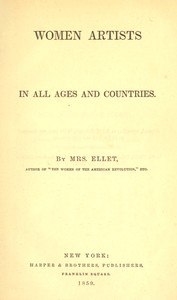
Before opening Women artists in all ages and countries — Background and Themes, the edition data offers a quick orientation: 109,421 words, 7 hr 56 min estimated reading time, and 34 detected text sections.
The text analysis averages about 18.0 words per sentence, while the detected sections provide another way to judge how the source is divided.
Project Gutenberg metadata also associates the work with “Women artists,” connecting these edition facts with the source record’s subject description.
Explore this collection
These alternatives are selected using recorded categories and estimated reading time.
About 471 minutes
Architecture
108,120 recorded words. 5 minutes difference from this book's estimate.
View Gutenberg source #39380About 463 minutes
Architecture
106,432 recorded words. 13 minutes difference from this book's estimate.
View Gutenberg source #76733About 457 minutes
Architecture
105,006 recorded words. 19 minutes difference from this book's estimate.
View Gutenberg source #64332Search stored excerpts and compare books → Choose by your preferences →
Choices use stored catalog measurements. Estimates vary with reading speed. A shared category is a catalog label, not a claim that two books have the same argument or literary quality.
Search reads excerpt text stored with this catalog and links to its associated Gutenberg record. The connection is stored in the site database; this tool does not recheck that every excerpt is word-for-word identical to that external record. Excerpt search does not cover every chapter and does not verify historical publication dates.
Catalog snapshot checked: 2026-09-25. Coverage: 94 public books, 94 available source excerpts.
Read the complete public-domain text at its original source.
Read on Project GutenbergEllet opens her 1859 volume with a clear statement of purpose: to show 'what woman has done' in the arts, focusing on personal experience rather than 'elaborate critiques or a connected history of art.' She acknowledges her debt to Ernst Guhl's German work but expands it to include living artists, drawing on materials from the artists themselves or their friends. The preface immediately establishes a biographical, almost novelistic approach—early struggles, persevering industry, well-earned triumphs—that shapes the entire book.
Ellet explicitly avoids art criticism. She writes that 'more may be learned by a view of the early struggles and trials, the persevering industry and the well-earned triumphs of the gifted, than by the most erudite or fine-spun disquisition.' This choice means the reader encounters each artist through her life story—her family, training, obstacles, and social context—rather than through analysis of her technique or style. The excerpts show this clearly: the biography of Élisabeth Vigée Le Brun, for instance, reads like a dramatic narrative, with headings such as 'Poverty and Labor,' 'Avaricious Step-father,' and 'The Mask falls.' Ellet foregrounds the artist's personal experiences, making the book a collection of life stories rather than an art-historical survey.
Ellet frequently compares the conditions of women artists across countries. In the French section, she notes that 'the number of female artists was far greater in Germany,' attributing this to Germany's multiple urban centers versus France's single focus on Paris. She also observes that French women 'devoted themselves much more to engraving' and operated 'more in a strictly business line,' while German and English women often worked as dilettanti. These comparative observations recur throughout the book, offering a structural framework that groups artists by nation and era. Readers can trace how Ellet uses these contrasts to highlight the influence of social and economic factors on women's artistic opportunities.
The extended treatment of Élisabeth Vigée Le Brun exemplifies Ellet's method. The chapter headings alone tell a story: 'Talent for Painting,' 'Her Father’s Delight,' 'Poverty and Labor,' 'Avaricious Step-father,' 'Success and Temptation,' 'Secret Marriage,' 'The Mask falls,' 'Luxury for the Husband, Labor and Privation for the Wife.' Ellet presents Le Brun's life as a series of dramatic reversals—early promise, exploitation, a disastrous marriage, then triumphant escape and international success. The narrative is shaped to inspire, as Ellet says, 'courage and resolution' in aspiring women. The account of Le Brun's flight from France and her 'triumphal progress' through Bologna, Rome, Naples, and Florence reads like a picaresque, with each city offering new honors. This biographical arc—struggle, betrayal, flight, and vindication—recurs in many of Ellet's portraits.
Ellet emphasizes the importance of patrons and friendships in her subjects' careers. Vigée Le Brun's 'Friendship with Vernet' and her 'Friendship with Marie Antoinette' are given their own headings, signaling how social connections enabled artistic work. Similarly, the book's dedication to Mrs. Coventry Waddell—'whose elegant taste and appreciation of art, and whose liberal kindness to artists, have fostered American genius'—underscores Ellet's belief in the power of enlightened patronage. Throughout the excerpts, artists succeed not only through talent but through the support of mentors, friends, and influential figures. This theme gives the book a practical dimension: it is not just a record of achievement but a guide to the networks that made achievement possible.
Ellet's book rewards readers who approach it as a series of biographical sketches rather than a unified history. The preface warns that the work does not attempt 'a connected history of art,' and the excerpts confirm that each artist's story stands largely on its own. Readers may find it useful to dip into individual chapters based on interest in a particular country or period, rather than reading straight through. The comparative observations scattered throughout—on national differences, professional practices, and the role of patronage—provide a thread that links the diverse lives Ellet chronicles.
Ellet's book feels like sitting with someone who remembers these women, their quiet persistence and small victories, rather than just their fame. I find myself thinking about that same patient, hand-wrought care in the older patterns too, the ones woven into Celtic art in Pagan and Christian times — A Closer Reading, where every knot seems to hold a story of someone’s steady, unnamed devotion.
Answer a few questions and save a private reflection on this device.