About 228 minutes
Greek Tragedy in the Light of Vase Paintings — Reading Notes
Architecture
52,342 recorded words. 7 minutes difference from this book's estimate.
View Gutenberg source #65461
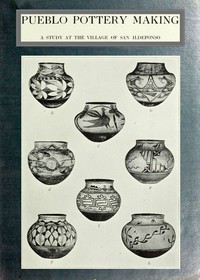
For Pueblo pottery making: a study at the village of San Ildefonso — Edition Insights, the stored edition analysis reports 50,739 words, 3 hr 41 min estimated reading time, and 8 detected text sections.
The text analysis averages about 19.0 words per sentence, while the detected sections provide another way to judge how the source is divided.
Project Gutenberg metadata also associates the work with “Indian pottery -- North America,” connecting these edition facts with the source record’s subject description.
Explore this collection
These alternatives are selected using recorded categories and estimated reading time.
About 228 minutes
Architecture
52,342 recorded words. 7 minutes difference from this book's estimate.
View Gutenberg source #65461About 204 minutes
Architecture
46,903 recorded words. 17 minutes difference from this book's estimate.
View Gutenberg source #63255About 195 minutes
Architecture
44,822 recorded words. 26 minutes difference from this book's estimate.
View Gutenberg source #64629Search stored excerpts and compare books → Choose by your preferences →
Choices use stored catalog measurements. Estimates vary with reading speed. A shared category is a catalog label, not a claim that two books have the same argument or literary quality.
Search reads excerpt text stored with this catalog and links to its associated Gutenberg record. The connection is stored in the site database; this tool does not recheck that every excerpt is word-for-word identical to that external record. Excerpt search does not cover every chapter and does not verify historical publication dates.
Catalog snapshot checked: 2026-09-25. Coverage: 94 public books, 94 available source excerpts.
Read the complete public-domain text at its original source.
Read on Project GutenbergCarl E. Guthe's Pueblo Pottery Making opens not with a general survey but with a precise inventory: red clay, white clay, temper, slips, paints, and fuel are each named and described before a single pot is formed. The frontispiece portrait of Maria Martinez, identified as "the most skillful potter of San Ildefonso," signals that this is a study grounded in specific practitioners, not abstract tradition. Guthe, working under the Department of Archaeology of Phillips Academy, structures his account as a step-by-step technical manual, yet the excerpts reveal an eye for the potter's own reasoning—why a crack appears, how a vessel's color signals dryness, what the potters themselves say about drying too quickly in the sun.
The book's table of contents reads like a process flow: Raw Materials, Moulding, Sun-Drying, Scraping, Slipping and Polishing, Painting, Firing. Each stage is broken into sub-stages, and each material is given its own entry. Guthe distinguishes between "native slip," "Santo Domingo slip," "red slip," "orange-red slip," and "black ware paint"—a classification that reflects the potter's own categories rather than a museum label. The opening chapter on paraphernalia lists moulds, moulding spoons, scrapers, polishing stones, and paint brushes, but also secondary items like mops, wiping-rags, and firing accessories. This granularity suggests that the study aims to capture not just the finished object but the entire material culture of the craft.
In the section on sun-drying, Guthe records that potters place vessels on a table overnight and find them dry enough by morning to lift from the pukis (base-mould). He notes that cloudy weather may prompt use of a wood-stove oven, with a piece of corrugated cardboard on the floor and the door left open. The description of cracks is particularly detailed: base cracks, rim cracks, and vertical body cracks are each attributed to contraction, with the base under greatest strain. Guthe reports that potters interpret many small cracks or a single serious one as a sign that more temper is needed. He also records the potters' own explanation—that fine vertical cracks near the base result from drying too quickly in the sun—without dismissing it in favor of his own analysis.
The frontispiece names Maria Martinez as "the most skillful potter of San Ildefonso," and the plate captions throughout identify other individuals: Antonita Roybal, who specializes in large red ollas, is shown with her summer house and a row of drying vessels. Guthe does not treat pottery as anonymous craft; he anchors techniques to specific women. The excerpts do not reveal whether Martinez is quoted directly, but the inclusion of her portrait and the naming of other potters indicate that the study values individual expertise. This personal dimension contrasts with the otherwise systematic, almost industrial tone of the technical chapters, and it invites the reader to consider how knowledge is passed from one potter to another within the pueblo.
Because the excerpts cover only the early and middle stages—raw materials, moulding, drying, and the beginning of scraping—the reader does not encounter the later steps of slipping, polishing, painting, or firing in detail. The table of contents promises those sections, but the available text stops before them. This means that any assessment of the complete work must remain provisional. What is clear is that Guthe's method is observational and descriptive, not experimental or comparative. He records what potters do and what they say, and he organizes that information into a logical sequence. A first-time reader should expect a dense, factual account that rewards careful attention to the terminology and the step-by-step logic of the craft.
Guthe's study is best approached as a field manual rather than a narrative. Readers who want to understand the physical reasoning behind each stage—why a crack forms, how slip consistency is judged, what fuel is preferred—will find the book invaluable. The excerpts suggest that the potter's own explanations are preserved alongside the archaeologist's observations, making this a document of both technical process and local knowledge. For those unfamiliar with Pueblo pottery, starting with the list of materials and paraphernalia will provide the vocabulary needed to follow the later, more complex descriptions of forming and decorating.
I found myself thinking of that quiet afternoon at San Ildefonso, watching Maria’s hands shape the clay, the patience in every pressed coil. It wasn’t the technique that lingered, but the care—the sense that each vessel carried something unspoken. That feeling surfaced again while leafing through Hopes and Fears for Art — Reading Notes, where craft and devotion seem to whisper together, as if both books share the same gentle heartbeat.
Your answers remain private and are stored only in this browser.