About 195 minutes
Sticks and Stones: A Study of American Architecture and Civilization — Story, Setting & Ideas
Architecture
44,822 recorded words. 9 minutes difference from this book's estimate.
View Gutenberg source #64629
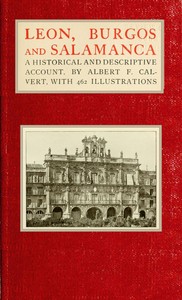
The catalog record for Leon, Burgos and Salamanca: a historical and descriptive account — A Closer Reading provides practical reading context through 46,903 words, 3 hr 24 min estimated reading time, and 11 detected text sections.
The text analysis averages about 19.4 words per sentence, while the detected sections provide another way to judge how the source is divided.
Project Gutenberg metadata also associates the work with “Architecture -- Spain,” connecting these edition facts with the source record’s subject description.
Explore this collection
These alternatives are selected using recorded categories and estimated reading time.
About 195 minutes
Architecture
44,822 recorded words. 9 minutes difference from this book's estimate.
View Gutenberg source #64629About 221 minutes
Architecture
50,739 recorded words. 17 minutes difference from this book's estimate.
View Gutenberg source #67221About 228 minutes
Architecture
52,342 recorded words. 24 minutes difference from this book's estimate.
View Gutenberg source #65461Search stored excerpts and compare books → Choose by your preferences →
Choices use stored catalog measurements. Estimates vary with reading speed. A shared category is a catalog label, not a claim that two books have the same argument or literary quality.
Search reads excerpt text stored with this catalog and links to its associated Gutenberg record. The connection is stored in the site database; this tool does not recheck that every excerpt is word-for-word identical to that external record. Excerpt search does not cover every chapter and does not verify historical publication dates.
Catalog snapshot checked: 2026-09-25. Coverage: 94 public books, 94 available source excerpts.
Read the complete public-domain text at its original source.
Read on Project GutenbergAlbert F. Calvert's 1907 volume on León, Burgos, and Salamanca belongs to a series that treats text as subordinate to illustrations. The preface explicitly disclaims the intention to write a guidebook, offering instead a souvenir for the 'amateur (in the true sense) of the arts.' The author avoids technical jargon and draws on multiple authorities, though he notes that quotations do not imply blind acceptance of their accuracy. The work's structure—historical sketches followed by descriptive accounts—reflects a dual aim: to provide context for the monumental glories of these cities while keeping the focus on visual documentation.
Calvert acknowledges that early history is 'speculative and debatable' and that modern writers have 'learnedly discounted' traditional accounts. He neither accepts nor rejects their criticism, citing conflicting conclusions as too complex for a 'slight work.' This hedging is evident in the Burgos chapter, where he notes that the castle's oldest masonry—a gate with a horse-shoe arch—is 'popularly ascribed' to Moorish domination, but he asserts it likely dates from the fourteenth century and was built by Mudéjar masons. The passage exemplifies his method: presenting popular belief, then offering a more precise dating based on style and craftsmanship, without overstating certainty.
The Salamanca section opens with a Spanish proverb—'Sword never blunted pen, nor pen sword'—which Calvert uses to frame the city's character. He describes its people as 'doughty warriors and learned scholars,' noting that the university nearly rivaled Oxford and Paris while the city served as a 'permanent camp' of fierce fighting men. This duality is presented as a historical pattern: the pen made Salamanca famous abroad, but the sword gave it renown at home. The excerpt also traces the city's origins to before the Roman conquest, citing Polybius and Plutarch, and recounts Hannibal's siege, where womenfolk performed 'heroic exploits.'
Calvert observes that Spanish provincial museums are 'as a rule, disappointing,' but makes an exception for Burgos's collection, housed in the Puerta Santa Maria. He highlights the alabaster effigy of Don Juan de Padilla, attributed to Gil de Siloe, describing its 'beautiful and expressive' face and the 'extraordinary richness' of the armor. The tomb's shields and inscription are noted. He also describes an eleventh-century bronze altar-front from Santo Domingo de Silos, in a 'bastard Byzantine style,' and a Moorish ivory casket with reliefs showing 'the Persian theory of the origin of good and evil.' The casket's Christian additions—Byzantine saints—are pointed out as evidence of later ownership.
Readers should approach this volume as a period piece that reflects early twentieth-century attitudes toward Spanish architecture and history. Calvert's reliance on visual documentation and his deliberate avoidance of technical language make the book accessible, but his cautious treatment of historical claims invites scrutiny. The excerpts suggest a work that is richest in its descriptive passages and its attention to material culture—sculpture, masonry, and decorative arts—rather than in its historical analysis.
Flicking through these plates, I remembered standing in Salamanca’s plaza myself, feeling small. Unlike the architects’ stern eye, this book’s quiet reverence for stone and memory reminds me of what Hellenistic sculpture — Themes and Context once stirred — that ache for hands lost to time, yet somehow still warm in the touch of a carved fold or a weathered arch.
Build a private reading journal entry for this title.