About 402 minutes
Art in England: Notes and Studies — Text and Context
Architecture
92,444 recorded words. 2 minutes difference from this book's estimate.
View Gutenberg source #20237
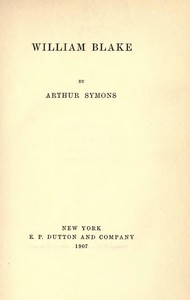
Before opening William Blake — Background and Themes, the edition data offers a quick orientation: 92,780 words, 6 hr 44 min estimated reading time, and 9 detected text sections.
The text analysis averages about 24.9 words per sentence, while the detected sections provide another way to judge how the source is divided.
Project Gutenberg metadata also associates the work with “Poets, English -- 19th century -- Biography,” connecting these edition facts with the source record’s subject description.
Explore this collection
These alternatives are selected using recorded categories and estimated reading time.
About 402 minutes
Architecture
92,444 recorded words. 2 minutes difference from this book's estimate.
View Gutenberg source #20237About 413 minutes
Architecture
94,889 recorded words. 9 minutes difference from this book's estimate.
View Gutenberg source #39886About 389 minutes
Architecture
89,280 recorded words. 15 minutes difference from this book's estimate.
View Gutenberg source #69619Search stored excerpts and compare books → Choose by your preferences →
Choices use stored catalog measurements. Estimates vary with reading speed. A shared category is a catalog label, not a claim that two books have the same argument or literary quality.
Search reads excerpt text stored with this catalog and links to its associated Gutenberg record. The connection is stored in the site database; this tool does not recheck that every excerpt is word-for-word identical to that external record. Excerpt search does not cover every chapter and does not verify historical publication dates.
Catalog snapshot checked: 2026-09-25. Coverage: 94 public books, 94 available source excerpts.
Read the complete public-domain text at its original source.
Read on Project GutenbergArthur Symons opens his 1907 study of William Blake by acknowledging a long personal engagement with the poet, yet he deliberately subordinates his own voice to the documentary record. The book is structured in two distinct parts: a compact interpretive narrative followed by a substantial appendix of primary sources, many printed verbatim for the first time. Symons draws on the work of earlier editors—Sampson, Rossetti, Swinburne—but his method is to let the witnesses speak. The result is a biography that feels less like a linear life story and more like a mosaic of contemporary testimony, held together by Symons's own measured commentary on Blake's intentions and achievements.
Symons makes explicit his plan to produce a book that would be, in his words, 'complete.' He reprints the full text of every personal account of Blake printed during his lifetime and between his death and Gilchrist's 1863 Life, including the complete Crabb Robinson diary entries transcribed from the original manuscripts. This editorial choice gives the reader direct access to the raw material of Blake's reputation, from the admiring to the baffled. Symons does not merely summarize these sources; he presents them as evidence, allowing the reader to weigh the testimony of Malkin, Lady Charlotte Bury, J. T. Smith, and Allan Cunningham. The effect is to foreground the act of interpretation itself, making the reader a participant in constructing Blake's character.
The excerpts from Blake's last year are dominated by his own voice, preserved in letters and reported speech. Writing to George Cumberland in April 1827, Blake describes himself as 'very weak and an old man, feeble and tottering, but not in the spirit and life, not in the real man, the imagination, which liveth for ever.' This distinction between bodily decay and imaginative permanence recurs in his reported deathbed utterances. He tells his wife, as she stands by, that the songs he sings are 'not mine, no, they are not mine.' The phrasing suggests a channeling of something beyond the self, consistent with his lifelong belief in inspiration. Symons lets these statements stand without excessive gloss, trusting their power to convey Blake's state of mind.
Symons draws heavily on two contrasting witnesses. Henry Crabb Robinson, the diarist, provides a rationalist's perplexed record of Blake's conversations, noting his claims to have seen visions and spoken with spirits. Robinson's tone is often skeptical but never dismissive, and his detailed entries offer a rare glimpse of Blake in social settings. Frederick Tatham, by contrast, writes as a devoted disciple. His account of Blake's death—the sudden decision to draw his wife's portrait, the singing of 'Hallelujahs and songs of joy'—is hagiographic in tone. Symons juxtaposes these voices without reconciling them, leaving the reader to navigate between the skeptical and the reverent. The effect is to underscore the difficulty of pinning down Blake's personality.
Symons's own writing occasionally echoes Blake's own dialectical style. He describes Blake's work as 'the marriage of heaven and hell,' a phrase that appears in the book's dedication to Rodin. In his narrative sections, Symons tends to pair opposites: the body and the spirit, the finite and the infinite, the law and the imagination. He writes of Blake's desire to 'get into freedom from all law of the numbers, into the mind, in which every one is king and priest in his own house.' This is not mere paraphrase; it is an attempt to inhabit Blake's conceptual world. Symons's prose is at its most vivid when he lets Blake's own formulations drive the argument, as when he quotes Blake's remark that 'every death is an improvement of the state of the departed.'
Symons's book is best approached as a documentary biography, one that values the texture of primary evidence over narrative smoothness. Readers interested in Blake's own voice will find the second part indispensable, while those seeking a critical interpretation will find Symons's first part concise and suggestive. The book does not attempt to resolve the contradictions in Blake's character or work; instead, it presents them as essential to his genius. For a reader new to Blake, this volume offers a way in through the words of those who knew him, and through the words of the poet himself, speaking from the edge of death.
Reading Symons’s William Blake, I recalled my grandmother’s worn copy of The spirit of American sculpture — Key Ideas to Explore, its margins filled with her pencil notes. She underlined the idea that art holds a life beyond its maker, much like Blake’s prophetic books felt alive to me once. The Spirit gave me that same quiet ache—stone and verse both whispering long after their creators fell silent.
Answer a few questions and save a private reflection on this device.