
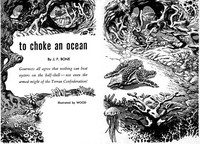
To Choke an Ocean by Jesse F. Bone
I stumbled upon this 1960s sci-fi gem and was immediately pulled into its unique, unsettling world. Jesse F. Bone crafts a story that feels both classic and surprisingly fresh.
The Story
The plot centers on Dr. Paul Avery, a brilliant physicist working on the fringes of known science. His experiments with temporal fields go catastrophically right—or wrong—when he accidentally creates a 'stasis bubble,' a zone where time simply stops. The military, seeing the ultimate weapon, quickly seizes control. But the bubble doesn't stay put. It begins to grow, consuming everything in its path, freezing it in a single, eternal moment. The race is on: Avery must find a way to reverse his creation before the entire planet, and eventually the ocean of time itself, is choked into permanent stillness. It's a fight against an enemy with no mind, no malice, just an unstoppable, silent expansion.
Why You Should Read It
What grabbed me wasn't just the cool science idea (though that's great), but the human drama at its core. Avery isn't a typical hero; he's a man crushed by the weight of his own genius, forced to fix the unfixable. Bone writes with a clear, direct style that makes complex concepts easy to grasp. The tension builds slowly and surely—you can feel the invisible wall of stopped time creeping closer, page by page. It explores themes of responsibility, hubris, and the unintended consequences of discovery without ever getting preachy. The ending genuinely surprised me and left me thinking about it for days.
Final Verdict
This book is perfect for readers who love classic, idea-driven science fiction like Arthur C. Clarke. If you enjoy stories where the real conflict is humanity versus a natural (or unnatural) phenomenon, rather than a villainous overlord, you'll find a lot to love here. It's also a fantastic pick for anyone who thinks older sci-fi can't feel urgent and relevant. To Choke an Ocean is a compact, powerful novel that proves a scary story doesn't need monsters—just a really, really bad day for physics.
This book is widely considered to be in the public domain. It is available for public use and education.
Linda Gonzalez
1 year agoFinally found time to read this!
Sarah Lewis
1 year agoLoved it.
Donald Scott
11 months agoSimply put, the arguments are well-supported by credible references. Truly inspiring.
Linda White
6 months agoI've gone through the entire material twice now, and it addresses the common misconceptions in a very professional manner. A trustworthy resource that I'll keep in my digital library.