About 111 minutes
Outdoor Sketching Four Talks Given before the Art Institute of Chicago; The Scammon Lectures, 1914 — A Reader’s Guide
Architecture
25,306 recorded words. 0 minutes difference from this book's estimate.
View Gutenberg source #27340
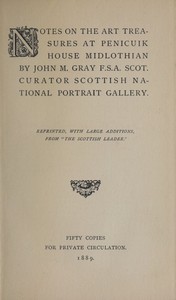
Notes on the Art Treasures at Penicuik House Midlothian — Themes and Context can be approached with a clearer sense of reading commitment from its source measurements: 25,381 words, 1 hr 51 min estimated reading time, and 4 detected text sections.
The text analysis averages about 32.4 words per sentence, while the detected sections provide another way to judge how the source is divided.
Project Gutenberg metadata also associates the work with “Penicuik House (Penicuik, Scotland),” connecting these edition facts with the source record’s subject description.
Explore this collection
These alternatives are selected using recorded categories and estimated reading time.
About 111 minutes
Architecture
25,306 recorded words. 0 minutes difference from this book's estimate.
View Gutenberg source #27340About 106 minutes
Architecture
24,155 recorded words. 5 minutes difference from this book's estimate.
View Gutenberg source #63798About 104 minutes
Architecture
23,794 recorded words. 7 minutes difference from this book's estimate.
View Gutenberg source #25654Search stored excerpts and compare books → Choose by your preferences →
Choices use stored catalog measurements. Estimates vary with reading speed. A shared category is a catalog label, not a claim that two books have the same argument or literary quality.
Search reads excerpt text stored with this catalog and links to its associated Gutenberg record. The connection is stored in the site database; this tool does not recheck that every excerpt is word-for-word identical to that external record. Excerpt search does not cover every chapter and does not verify historical publication dates.
Catalog snapshot checked: 2026-09-25. Coverage: 94 public books, 94 available source excerpts.
Read the complete public-domain text at its original source.
Read on Project GutenbergGray begins not with a painting but with a family: the Clerks of Penicuik. The opening paragraph traces their lineage through seven generations, naming baronets, commissioners, architects, and scientists—including James Clerk Maxwell. This genealogical framing signals that the art collection will be understood as an expression of family identity, not merely an inventory. The prose is dense with proper names and achievements, establishing a tone of antiquarian precision. A first-time reader should note how Gray uses the family tree as a map: each artist or artifact mentioned later will likely connect back to a specific Clerk patron or relative.
The opening pages of Notes on the Art Treasures at Penicuik House do not describe a single painting. Instead, Gray devotes several paragraphs to the Clerk family’s intellectual and political history. He names Sir John Clerk, second Baronet, as “a man of varied attainments and the strongest individuality,” and notes that William Aikman the portrait-painter was descended from the house. This is not background decoration; it is a deliberate method. Gray treats the collection as a biographical record. When a reader later encounters a portrait by Aikman or a landscape commissioned by Sir James, the genealogical preface supplies the context. The opening thus functions as a key: without it, the catalogue entries would lack their connective tissue.
Midway through the text, Gray reproduces letters from Lord Eldon and others. These are not mere appendices; they are treated as art treasures in their own right. One letter, dated June 29, 1829, thanks Lady Clerk for a gift of jewellery, with Lord Eldon writing that “the Grampians can furnish what equals, if it does not surpass them, in beauty and brilliancy.” Another recounts a dinner at which Captain Morris confessed to having been “ardently in Love for the whole of his Life” with Lady Clarke. Gray lets these documents speak, offering only brief contextual notes. For a first-time reader, these letters shift the focus from objects to relationships—the collection becomes a web of personal history.
Gray’s own voice is that of a curator and antiquary. He uses phrases like “curiously enough” and “varying versions of the story” when recounting the birth of Lord Stowell, who was allegedly lowered in a basket from Newcastle’s town wall. This anecdote, like the letters, is presented without judgment. Gray does not argue for the collection’s aesthetic merit; he assumes it. His tone is descriptive, not evaluative. Readers should expect a catalogue that prioritizes provenance and anecdote over criticism. The work was originally published in The Scottish Leader and later expanded, then printed privately in fifty copies—a fact that explains its intimate, almost conversational quality.
The excerpts available here cover only the beginning and a middle section of the text. They reveal Gray’s method but not the full scope of the collection. The catalogue likely includes paintings, sculptures, and decorative arts, but the excerpts do not list them. A first-time reader should not assume that the entire book follows the genealogical and epistolary pattern of these pages. The later portions may shift to more conventional catalogue entries. The letters and family history may serve as an introduction to a longer inventory. Without the complete text, the balance between narrative and list remains uncertain.
Gray’s Notes rewards a reader who attends to names and dates. The opening genealogy is not a preamble but a framework; the letters are not digressions but primary sources. Approach the text as a guided tour by a curator who assumes your interest in the Clerks as much as in their art. The private printing and limited original audience suggest that Gray wrote for connoisseurs, not casual visitors. Let the family tree be your map, and the letters your windows into the lives behind the objects.
That catalogue at Penicuik House—the way its editor lets the family tree and old letters soften the edges of what’s just inventory—stayed with me like a quiet afternoon. It reminded me of From Seven to Seventy: Memories of a Painter and a Yankee — Reading Notes, where memory drifts gently between faces and rooms, never rushing to explain itself. Both feel less like records, more like held breaths.
Answer a few questions and save a private reflection on this device.