About 62 minutes
Homer Martin, a Reminiscence, October 28, 1836-February 12, 1897 — Key Ideas to Explore
Architecture
14,080 recorded words. 0 minutes difference from this book's estimate.
View Gutenberg source #55498
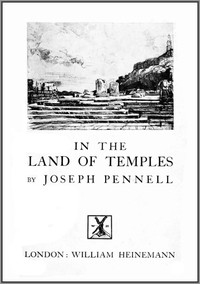
The catalog record for Joseph Pennell's Pictures in the Land of Temples Reproductions of a Series of Lithographs Made by Him in the Land of Temples, March-June 1913, Together with — Background and Themes provides practical reading context through 14,102 words, 1 hr 2 min estimated reading time, and 2 detected text sections.
The text analysis averages about 27.1 words per sentence, while the detected sections provide another way to judge how the source is divided.
Project Gutenberg metadata also associates the work with “Lithography, American,” connecting these edition facts with the source record’s subject description.
Explore this collection
These alternatives are selected using recorded categories and estimated reading time.
About 62 minutes
Architecture
14,080 recorded words. 0 minutes difference from this book's estimate.
View Gutenberg source #55498About 61 minutes
Architecture
13,971 recorded words. 1 minutes difference from this book's estimate.
View Gutenberg source #57660About 61 minutes
Architecture
13,998 recorded words. 1 minutes difference from this book's estimate.
View Gutenberg source #64054Search stored excerpts and compare books → Choose by your preferences →
Choices use stored catalog measurements. Estimates vary with reading speed. A shared category is a catalog label, not a claim that two books have the same argument or literary quality.
Search reads excerpt text stored with this catalog and links to its associated Gutenberg record. The connection is stored in the site database; this tool does not recheck that every excerpt is word-for-word identical to that external record. Excerpt search does not cover every chapter and does not verify historical publication dates.
Catalog snapshot checked: 2026-09-25. Coverage: 94 public books, 94 available source excerpts.
Read the complete public-domain text at its original source.
Read on Project GutenbergJoseph Pennell opens his 1915 lithographic record with a blunt confession: he went to Greece partly because a Boston critic called him a 'ragtime sketcher' who could not draw Greek art. That challenge shaped a book that is as much about the artist's eye as about the temples themselves. Pennell, who had already documented the Panama Canal, brings the same energetic, unromantic approach to the Parthenon and the temple at Aegina. He admits he knows no Greek and has 'scarce read a translation,' yet he insists that his lack of classical learning let him see the sites freshly. The resulting volume pairs full-page lithographs with informal notes that treat the ruins not as sacred relics but as problems of light, line, and placement.
Pennell frames his journey as a personal test. He wanted to see 'if the greatest work of the past impressed me as much as the greatest work of the present.' That comparative impulse runs through his notes. He is less interested in dates or cults than in how a temple 'told from afar by sea or land.' The Greeks, he argues, had a 'great feeling for site'—they placed buildings so that the landscape 'leads up to them.' His lithographs emphasize this relationship: the temple at Aegina sits 'in a lonely spot amidst the wild woods,' and the Sacred Way to Eleusis winds 'over the hills.' Pennell’s eye is that of a printmaker trained on industrial subjects, and he finds in Greek architecture a similar clarity of form against a dramatic backdrop.
Pennell’s text includes a long passage on the Athenian cemetery, where tombs are 'monuments of grace' with 'delicate reliefs' and inscriptions that show 'a manly acceptance of fate.' He contrasts this with modern funerary ugliness. The description of the Eleusinian Mysteries—'they were mysteries in so far that no one might reveal them unlawfully'—is drawn from a source he does not name, possibly a guidebook. Yet his own voice cuts through when he notes that 'the gorgeous ceremony is over, priests and worshippers have for ever gone, and nothing remains but the pavement of the temple, with a tiny church of the Virgin perched on a bluff above it.' The juxtaposition of pagan ruin and Christian chapel is exactly the kind of visual contrast that drives his lithographs.
Pennell pauses on Aegina’s small size—'only about forty square miles'—to marvel at its historical reach. He recounts that here, according to tradition, 'Pheidon, tyrant of Argos, first struck coins in Greece,' and that the Aeginetan tortoise was one of the three standard coin types of the Greek world. This digression into economic history is typical of his method: he lets facts accumulate without forcing a thesis. The temple itself, he notes, was sacred to Aphaia, not Zeus, as 'Furtwängler infers from inscriptions.' Pennell does not pretend to expertise; he reports what he has been told. The effect is a book that feels like a sketchbook in prose—observant, selective, and unafraid to leave gaps.
Pennell’s volume is best read as a companion to the plates, not as a systematic guide. His notes wander from personal anecdote to archaeological detail, mirroring the way a traveler’s attention shifts. Readers interested in the technical side of lithography will find hints of his process; those curious about early twentieth-century American responses to Greece will find a frank, unsentimental record. The book rewards slow looking—first at the images, then at the words that frame them.
Pennell’s Greek ruins feel less like postcards and more like a quiet conversation between stone and light—he lets the landscape breathe around the temples. That same unhurried attention to how a place shapes what we build came back to me while turning through The spirit of American sculpture — Key Ideas to Explore, where form and feeling seem to hold each other just as gently.
Capture what you thought, learned, and would like to remember.