
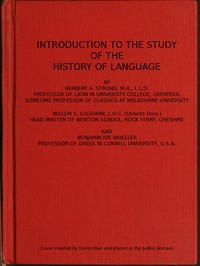
Introduction to the study of the history of language by Herbert A. Strong et al.
Forget the dry, intimidating textbook the title might suggest. Introduction to the Study of the History of Language is more like a time capsule of intellectual curiosity. Written by a team of scholars led by Benjamin Ide Wheeler, it captures a specific moment in the late 19th century when people were obsessed with figuring out the scientific laws behind everything—including how we talk.
The Story
The book doesn't have a plot in the traditional sense. Instead, it walks you through the life cycle of language. The authors break down how sounds in a language gradually change over time (imagine the Great Vowel Shift as a slow-motion avalanche). They explore how new words are created, often from old ones, and how grammar itself isn't set in stone but evolves. They look at how languages split into dialects and then into entirely new languages, like tracing a family tree for French, Spanish, and Italian back to Latin. The whole project is an attempt to find order and predictable patterns in what seems like the chaos of everyday speech.
Why You Should Read It
What grabbed me was the sheer detective work involved. These guys didn't have databases or audio recordings. They were comparing old texts, looking at spelling variations in medieval manuscripts, and listening to contemporary dialects to reconstruct a history no one had ever recorded. It makes you appreciate every word you use. That simple word "night" has a history stretching back thousands of years, its sound slowly smoothing out from something like "niht" to what we say today. Reading this is a reminder that language is a collective, ongoing project we're all participating in, whether we realize it or not.
Final Verdict
This isn't a light beach read, but it's surprisingly accessible for a book over a century old. It's perfect for curious minds who love history, words, or big ideas about human culture. If you've ever wondered why English spelling is so weird, or why some languages sound similar, this book provides the foundational thinking that started to answer those questions. Think of it as the origin story for modern linguistics, told with the passion of pioneers mapping uncharted territory. Just be ready for some old-fashioned phrasing and the occasional outdated theory—it's all part of the historical charm.
This masterpiece is free from copyright limitations. You do not need permission to reproduce this work.
Susan Perez
1 year agoSurprisingly enough, the depth of research presented here is truly commendable. Exactly what I needed.





Dorothy Miller
9 months agoHaving read this twice, the pacing is just right, keeping you engaged. I couldn't put it down.